
Sweepstakes vs Real Money Casinos: US Market Comparison
 Available in US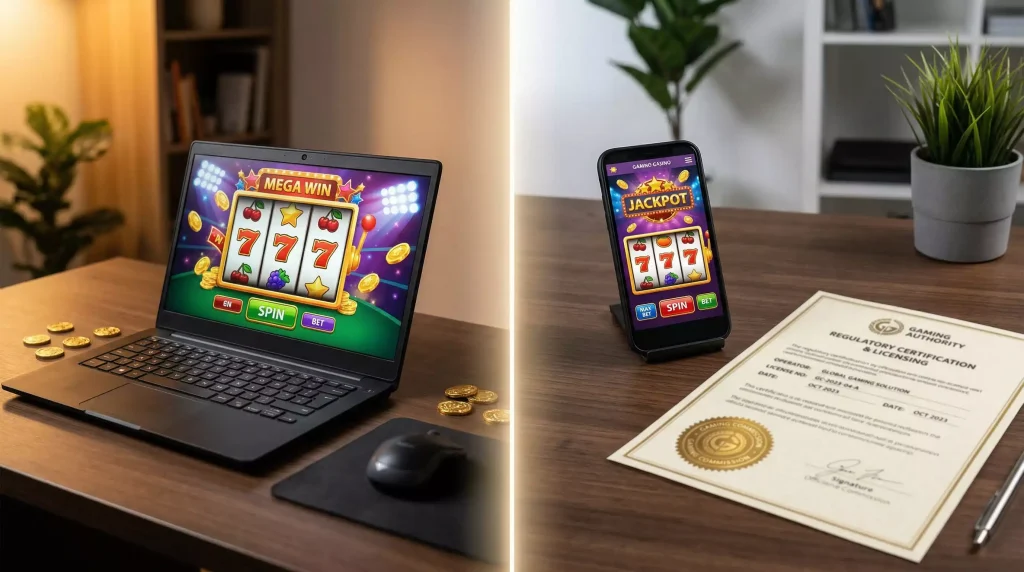
Two casino experiences sit on your screen. Both offer slot machines with spinning reels, blackjack tables with virtual cards, and the promise of excitement. One operates under state gaming licenses with strict regulatory oversight. The other runs as a promotional sweepstakes under consumer protection laws. The games look identical. The underlying business models could not be more different.
Understanding these differences matters for anyone considering where to play. Sweepstakes casinos and real money casinos represent different models, similar entertainment—they deliver comparable gameplay experiences through fundamentally distinct legal and financial structures. Choosing between them involves weighing factors like accessibility, regulation, and how you prefer to handle transactions.
The scale of both markets reveals their significance. According to KPMG’s industry analysis, the global social casino market generated approximately $7.1 billion in gross revenue during 2026, while sweepstakes casinos with prize redemption exceeded $14 billion in sales during 2026. Traditional regulated iGaming, meanwhile, operates on a different trajectory entirely—limited to fewer states but growing rapidly within those markets.
This comparison examines both casino types across every dimension that matters to players. We will explore legal frameworks, gameplay experiences, financial mechanics, market dynamics, and regulatory environments. Neither model is inherently superior—each serves different player needs and operates under different constraints. By the end, you will have the information needed to determine which approach fits your circumstances and preferences.
Core Differences: Sweepstakes and Real Money Gambling
Real money casinos are gambling establishments in the traditional legal sense. Players deposit actual currency, wager that currency on games of chance, and withdraw winnings as cash. The relationship between money in and money out is direct and unambiguous. State gaming commissions regulate these operations under gambling statutes that govern everything from game fairness to advertising practices.
Sweepstakes casinos present themselves differently under the law. They operate as promotional sweepstakes platforms where players purchase virtual currency packages—Gold Coins—and receive Sweeps Coins as a free bonus. The Sweeps Coins function as sweepstakes entries that can be played on casino-style games and eventually redeemed for prizes. The legal distinction rests on the claim that players are buying entertainment currency, not gambling stakes, and that free entry methods always exist.
The definitional gap creates practical consequences. Real money casinos can only operate in states that have specifically legalized online gambling. Sweepstakes casinos claim authorization under promotional sweepstakes laws that exist in most states, allowing them to serve players in markets where traditional online gambling remains illegal. This geographic advantage explains much of the sweepstakes model’s growth.
Terminology differs between the two models in revealing ways. Real money casinos use straightforward gambling language: deposits, wagers, winnings, withdrawals. Sweepstakes casinos maintain alternative vocabulary: purchases, plays, prizes, redemptions. The linguistic distinction is not merely semantic—it reflects the legal framework each model claims to operate within. Whether courts and regulators accept these distinctions varies by jurisdiction.
From a player perspective, the activities can feel identical. You spin slots, play cards, and hope for favorable outcomes. The money flows differently beneath the surface, but the entertainment experience overlaps substantially. This similarity contributes to regulatory concerns—if the experience matches gambling, should the legal classification differ simply because of how the transaction is structured?
Legal Framework Comparison
Real money online casinos operate under state gambling licenses. Each state that permits iGaming has enacted specific legislation authorizing online casino operations, established a regulatory agency to oversee operators, and created licensing requirements that platforms must meet. New Jersey, Pennsylvania, Michigan, and West Virginia represent the largest regulated markets, each with distinct regulatory frameworks that operators must navigate.
The licensing process for real money casinos involves extensive vetting. Operators submit detailed applications covering corporate structure, financial resources, security systems, and responsible gaming programs. Background checks examine key personnel. Technical standards ensure game fairness and data protection. The process can take months and cost millions of dollars in application fees, legal work, and compliance infrastructure.
Sweepstakes casinos claim authorization under a different legal theory. Rather than seeking gambling licenses, they argue their operations qualify as promotional sweepstakes exempt from gambling regulation. The key requirements—no purchase necessary, prizes with real value, winner selection by chance—theoretically remove the “consideration” element that distinguishes gambling from sweepstakes under most state laws.
According to KPMG research, legal iGaming operates in only seven to eight US states, while sweepstakes casinos maintain operations in thirty-five or more states. This availability disparity reflects the different legal burdens each model faces. Real money casinos need affirmative legislative authorization. Sweepstakes casinos operate until legislators or courts specifically prohibit them.
The legal frameworks produce different consumer protection environments. Real money casinos face mandatory responsible gaming requirements, regular audits, and regulatory oversight of customer complaints. Sweepstakes casinos may implement similar programs voluntarily but face no regulatory mandate. Player recourse differs accordingly—disputes with licensed casinos can involve gaming commissions, while sweepstakes disputes typically fall under general consumer protection mechanisms.
Federal law treats both models distinctly. The Unlawful Internet Gambling Enforcement Act prohibits financial transactions related to illegal online gambling but exempts games legal under state law. Real money casinos in licensed states clearly qualify for this exemption. Sweepstakes casinos argue their promotional model qualifies as well, since sweepstakes are legal in most states. This interpretation enables payment processing that would be unavailable to unlicensed gambling operations.
Gameplay Experience
The actual gaming experience on both platforms converges remarkably. Both offer slot machines from recognized providers, table games with standard rules, and interfaces designed for intuitive navigation. A player switching between a licensed online casino and a sweepstakes platform would notice the different currency labels but might struggle to identify other meaningful differences in the games themselves.
Game providers supply both markets. Companies like NetEnt, Pragmatic Play, and BGaming license their titles to regulated casinos and sweepstakes platforms alike. The same slot machine with the same graphics, bonus features, and mathematical model might appear on both types of platforms. Return-to-player percentages, volatility characteristics, and hit frequencies remain constant regardless of which platform hosts the game.
Player perceptions reflect this similarity. According to the American Gaming Association’s 2026 survey, sixty-nine percent of sweepstakes casino users describe these platforms as places for real-money betting. The promotional sweepstakes framing does not translate to player experience—people understand they are playing casino games for the chance to win money, regardless of how the legal structure characterizes the activity.
Stakes work differently despite the similar gameplay. Real money casinos display actual dollar amounts—bet $5, win $50. Sweepstakes casinos display virtual currency units—bet 5 Sweeps Coins, win 50 Sweeps Coins. The conversion rate typically runs one-to-one for Sweeps Coins to dollars at redemption, but the abstraction layer creates psychological distance from real money. Some players appreciate this buffer; others find it unnecessary friction.
Progressive jackpots illustrate both similarities and differences. Both platform types offer progressive slots that accumulate prizes across player spins. Real money casinos display jackpots in dollars and pay them in dollars. Sweepstakes casinos display jackpots in Sweeps Coins and pay them as prizes requiring redemption. The excitement of a jackpot win feels similar, but the path to accessing those funds differs.
Live dealer games have expanded on both platforms. Real dealers operating physical tables stream to players who make decisions in real time. The technology and experience are essentially identical. Real money casinos offered live games first and maintain larger selections, but sweepstakes platforms have added live dealer options that approach parity in quality if not always variety.
Financial Transactions
Money enters real money casinos through deposit mechanisms familiar to anyone who has used online financial services. Players add funds via credit cards, debit cards, bank transfers, PayPal, or platform-specific methods like Play+ prepaid cards. The deposit amount appears immediately as a playable balance. The transaction is straightforward: real dollars in, real dollars available to wager.
Sweepstakes casinos structure the inbound transaction differently. Players purchase Gold Coin packages with real money and receive Sweeps Coins as a promotional bonus. A $9.99 purchase might include ten million Gold Coins plus thirty Sweeps Coins. The framing positions Gold Coins as the product being purchased, with Sweeps Coins as free bonuses. This structure supports the legal argument that players are not purchasing gambling stakes.
Withdrawal processes also differ substantially. Real money casino withdrawals involve requesting funds from your player account and receiving them through your chosen payment method. Processing times vary by casino and payment method but typically range from same-day to several business days. Licensed casinos must maintain sufficient reserves to cover player balances and process withdrawals promptly.
Sweepstakes casino redemptions involve converting Sweeps Coins to cash prizes. Minimum thresholds apply—typically fifty to one hundred Sweeps Coins before redemption becomes available. Playthrough requirements may require wagering promotional Sweeps Coins before redemption. KYC verification precedes first-time redemptions, requiring identity documentation that licensed casinos may request at different points in the customer relationship.
Processing times for sweepstakes redemptions often exceed real money casino withdrawals. The combination of verification requirements, platform review procedures, and payment processing creates timelines that can stretch to seven to ten business days. Some players find this acceptable; others prefer the faster access to winnings that regulated casinos typically provide.
Payment method availability differs between platforms. Real money casinos often partner with multiple payment processors and offer numerous deposit and withdrawal options. Sweepstakes casinos may have fewer banking relationships, limiting payment choices. Cryptocurrency options appear on some sweepstakes platforms, providing alternatives when traditional banking relationships prove difficult to establish.
Bonus structures reflect the different transaction models. Real money casinos offer deposit matches, free spins, and cashback tied to actual dollar amounts. Sweepstakes casinos provide Gold Coin and Sweeps Coin bonuses, daily login rewards, and social media promotions. The value calculations differ, but both models use bonuses to attract and retain players.
Market Size Comparison
The regulated iGaming market has grown steadily within its limited geographic footprint. According to the American Gaming Association’s revenue tracking, online casino gaming exceeded one billion dollars in monthly revenue for the first time in December 2026, reaching $1.03 billion with year-over-year growth of 22.4%. The market demonstrates strong momentum but remains constrained by state-level authorization requirements.
Sweepstakes casino growth has outpaced regulated iGaming in percentage terms. KPMG reports compound annual growth rates between sixty and seventy percent from 2020 through 2026. The 2026 market exceeded fourteen billion dollars in gross sales—a figure that dwarfs regulated iGaming despite the sweepstakes model’s younger history. Geographic accessibility explains much of this disparity: sweepstakes casinos reach players in states where regulated online gambling cannot operate.
Market dynamics differ in important ways. Real money casinos compete within regulated state markets where licensing requirements limit the number of operators. The competitive environment involves established gambling brands with substantial marketing resources. Customer acquisition costs are high, but customer lifetime values justify the investment given clear regulatory frameworks.
Sweepstakes casinos compete nationally across a fragmented regulatory landscape. New operators can enter without gaming licenses, lowering barriers to competition. Marketing spend has surged as platforms compete for players in accessible states. The competitive intensity manifests in aggressive bonus offers and advertising campaigns that saturate digital channels where potential players spend time.
Player demographics show some variation between markets. Regulated iGaming operates in states with generally higher incomes and established gambling cultures. Sweepstakes platforms reach broader geographic and demographic distributions, including states with limited gambling options and players who might not visit traditional casinos. The sweepstakes model serves markets that regulated gambling has not reached.
Future trajectories remain uncertain for both segments. iGaming expansion to additional states would capture revenue currently flowing to sweepstakes platforms. Sweepstakes casino bans reduce the addressable market for that model. Both industries watch legislative developments closely, understanding that regulatory changes could dramatically reshape competitive dynamics.
Regulatory Environment
Real money casinos operate under comprehensive regulatory oversight. State gaming commissions maintain ongoing supervision of licensed operators. Regular audits verify financial stability and game fairness. Responsible gaming requirements mandate self-exclusion programs, deposit limits, and problem gambling resources. Advertising restrictions govern how casinos can market their services. The regulatory burden is substantial but creates a framework of consumer protection.
The broader gambling industry context illustrates regulatory scale. According to the American Gaming Association’s Commercial Gaming Revenue Tracker, commercial casinos across the United States generated $78.72 billion in gross gaming revenue during 2026, representing 9.2% growth over the prior year. This enormous industry operates under state licensing frameworks that have evolved over decades to address consumer protection, problem gambling, and fair play concerns.
Sweepstakes casinos face minimal specific regulation. No state gaming commission oversees their operations. Game fairness audits occur voluntarily if at all. Responsible gaming programs exist at operator discretion rather than regulatory mandate. The platforms operate under general consumer protection laws and sweepstakes regulations rather than gambling-specific oversight frameworks.
This regulatory gap concerns critics who argue sweepstakes casinos deliver gambling experiences without gambling protections. The AGA and state regulators have highlighted the absence of problem gambling safeguards, customer complaint mechanisms, and game fairness verification. Industry defenders counter that reputable operators voluntarily implement similar programs and that the regulatory gap reflects the promotional rather than gambling nature of the activity.
Tax treatment differs significantly. Real money casinos pay gaming taxes on their revenue—rates vary by state but often exceed twenty percent. These taxes fund state programs and represent a major policy motivation for iGaming legalization. Sweepstakes casinos pay no gaming taxes, classifying their operations as promotional rather than gambling activities. This tax advantage contributes to state-level hostility from legislators who see sweepstakes platforms diverting potential tax revenue.
Enforcement actions against sweepstakes casinos have increased as regulators adopt more aggressive postures. Multiple states have issued cease-and-desist orders, enacted specific bans, or supported litigation challenging the sweepstakes model. The regulatory environment for sweepstakes casinos has shifted from benign neglect toward active scrutiny in many jurisdictions.
Industry Perspective
Industry analysts view sweepstakes casinos as a market response to regulatory constraints on traditional iGaming. The slow pace of state-by-state iGaming legalization left large populations without legal access to online casino games. Sweepstakes platforms filled that gap using a legal framework that sidestepped gambling regulations entirely.
“Social sweepstakes is an answer to the online casino legislation logjam,” observed Chris Grove, Partner at Eilers & Krejcik Gaming. “Online casino bills are not going anywhere. They aren’t. And I’ve been saying this for like the last six years, and it’s the thing I’ve been the most right about. Opposition to these bills is arguably growing, not receding.”
This perspective explains why sweepstakes casinos grew fastest in states without iGaming. California, Texas, Florida—large population states with no legal online gambling—became sweepstakes industry strongholds. Players who wanted casino-style games had limited options, and sweepstakes platforms provided an accessible alternative regardless of state gambling laws.
The regulated gambling industry views sweepstakes casinos as competitors who play by different rules. Licensed operators invest in compliance, pay substantial taxes, and maintain responsible gaming programs. Sweepstakes platforms avoid these costs while serving the same customer base. The competitive asymmetry frustrates regulated operators and motivates their lobbying for sweepstakes restrictions.
Consumer psychology favors the sweepstakes model in certain respects. As Grove further explained, “Consumers like this product because it does not force them to make the same hard decision to self-identify as a gambler by putting down a credit card in order to play games for the chance to win a prize.” The Gold Coin purchase structure creates psychological distance from gambling—players can frame they are buying entertainment value rather than gambling stakes. Daily bonuses and social media promotions provide free play opportunities that licensed casinos cannot easily replicate. The accessibility and framing attract players who might hesitate to engage with explicit gambling.
Both industry segments anticipate continued evolution. iGaming advocates expect additional states to legalize regulated online gambling over time. Sweepstakes operators prepare for further geographic restrictions while exploring regulatory frameworks that might legitimize their model. The relationship between these market segments will likely shift as legal and regulatory landscapes develop.
Which Is Right for You
Geographic availability determines your options before preferences matter. If you live in New Jersey, Pennsylvania, Michigan, or another state with legal iGaming, both options exist. If you live in Texas, California, or most other states, sweepstakes casinos represent your only option for legal online casino-style gaming—assuming sweepstakes platforms serve your state.
Regulatory comfort levels vary among players. Some prefer the oversight and consumer protections that licensed casinos provide. Knowing a gaming commission reviews complaints and audits games offers peace of mind. Others feel comfortable with sweepstakes platforms that operate reputable businesses despite minimal regulatory oversight. Your risk tolerance for platform reliability influences this choice.
Transaction preferences matter. If fast withdrawals and straightforward banking relationships appeal to you, regulated casinos typically deliver better experiences. If the Gold Coin purchase model feels comfortable and you accept longer redemption timelines, sweepstakes casinos present no obstacles. Consider how you want money to flow in and out of your gaming activity.
Bonus value calculations differ between models. Regulated casinos offer deposit matches that scale with your funding. Sweepstakes casinos provide daily login bonuses and social promotions that reward consistent engagement. Players who prefer occasional large deposits might favor regulated casino bonuses. Players who prefer steady small bonuses over time might prefer sweepstakes platform structures.
Neither model guarantees positive outcomes. Both offer games with mathematical house edges that ensure long-term operator advantage. Entertainment value rather than profit expectation should drive your participation regardless of which platform type you choose. Responsible gaming principles apply equally to regulated casinos and sweepstakes platforms.
Conclusion
Sweepstakes casinos and real money casinos deliver different models, similar entertainment. The games overlap substantially—often identically. The legal frameworks, financial structures, and regulatory environments differ fundamentally. Understanding these distinctions helps players make informed choices about where and how they engage with online casino gaming.
Real money casinos offer straightforward gambling with regulatory oversight, consumer protections, and clear transaction flows. Their limited geographic availability restricts access to players in states that have legalized iGaming. Sweepstakes casinos offer comparable entertainment through a promotional framework that reaches more states but operates with less regulatory scrutiny.
Market dynamics continue evolving. Additional states may legalize iGaming, expanding regulated options. Other states may ban sweepstakes casinos, contracting that model’s reach. Players should verify current availability and regulatory status rather than assuming either option will remain unchanged. The landscape that exists today reflects ongoing legal and political developments that will continue reshaping both industry segments.
Choose based on your circumstances, preferences, and risk tolerance. Both models can deliver entertaining casino experiences when accessed responsibly. Neither guarantees winnings or eliminates the mathematical advantages built into casino games. Approach either option with realistic expectations and appropriate limits on your gaming activity.