
Sweepstakes Casino Legal States: 2026 US Availability
 Available in US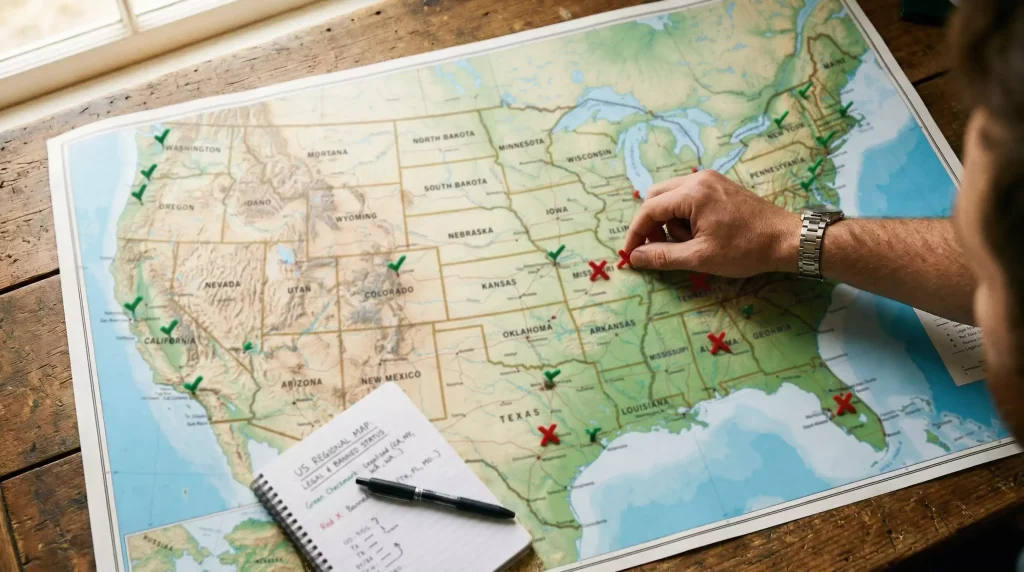
The legal status of sweepstakes casinos varies by state—and 2026 changed the landscape dramatically. What was once a relatively unregulated industry operating across most of the country now faces explicit prohibitions in multiple states, mounting enforcement actions, and pending legislation that could further reshape availability.
For players, understanding where sweepstakes casinos operate legally has become essential. Access that existed last year may have disappeared. States that seemed stable have implemented bans. And the regulatory momentum suggests more changes are coming.
This guide maps the current legal landscape as of 2026. We’ll cover where you can play without restrictions, which states have banned sweepstakes casinos outright, and where enforcement actions have created uncertain situations. The information draws from legislative records, regulatory announcements, and industry reporting to provide accurate, current data.
One comparison illustrates why legal status varies by state so significantly: traditional online casinos (iGaming) currently operate legally in only seven or eight US states. According to KPMG’s industry analysis, sweepstakes casinos have historically been accessible in 35 or more states. That broader availability drove the industry’s rapid growth—but it also attracted regulatory attention that has begun to narrow those numbers.
The situation remains fluid. State legislatures continue introducing bills that would either ban or regulate sweepstakes platforms. Enforcement agencies have issued cease-and-desist letters in increasing numbers. Court cases challenging the sweepstakes model are working through the legal system. Players need current information to make informed decisions about where and whether to play.
Legal Basis for Sweepstakes Casinos in the US
Sweepstakes casinos claim legal operation under promotional sweepstakes law, not gambling law. The argument rests on a specific legal distinction: gambling requires consideration (something of value) risked for a chance at a prize. Legitimate sweepstakes eliminate consideration by offering free entry methods, thereby falling outside gambling definitions.
At the federal level, this argument has generally held. The Unlawful Internet Gambling Enforcement Act (UIGEA) targets financial transactions related to illegal online gambling, but sweepstakes promotions—when properly structured—don’t trigger these provisions. This federal framework has allowed sweepstakes casinos to process payments through standard banking channels and operate openly in most states.
State gambling laws, however, vary considerably. Some states have broadly written statutes that may encompass sweepstakes-style gaming. Others have explicit exemptions for promotional sweepstakes. And several have recently passed legislation specifically targeting sweepstakes casinos, regardless of their compliance with traditional sweepstakes law.
The three elements of a valid sweepstakes—free entry, no purchase necessary to win, and prize allocation independent of purchase—serve as the legal foundation. Platforms structure their operations around these requirements: they offer mail-in requests for free coins, ensure free entries have identical odds to purchased entries, and separate the Gold Coin purchase from the Sweeps Coin bonus. Whether this structure satisfies each state’s gambling laws remains the central legal question.
Some regulators have accepted the sweepstakes argument; others have rejected it explicitly. The lack of consistent federal guidance means each state’s interpretation controls within its borders. This creates the patchwork legal landscape that players must navigate—and that operators must monitor constantly as laws evolve.
Court cases testing the sweepstakes model have produced mixed results. Some plaintiffs argue that the practical reality—players spending money and receiving variable returns—constitutes gambling regardless of technical compliance with sweepstakes requirements. Defendants counter that legal structure, not player behavior, determines regulatory classification. These cases continue working through courts with no definitive nationwide ruling established.
States with Full Access
Most US states currently permit sweepstakes casino operation, though “permit” often means simply “have not prohibited.” Few states have explicitly legalized and regulated sweepstakes casinos; most allow them by default because existing laws don’t clearly prohibit properly structured sweepstakes promotions.
The largest player populations exist in states with large adult populations, broad internet access, and no explicit restrictions. Texas, Florida, Pennsylvania, Ohio, and Illinois all host significant sweepstakes casino activity. These states combine substantial populations with favorable or ambiguous legal environments.
Florida represents a particularly important market. The state has an established gambling culture (through tribal casinos, sports betting, and the lottery), a large retiree population with leisure time, and no current prohibition on sweepstakes casinos. According to Eilers & Krejcik Gaming estimates, Florida accounts for roughly 8.5% of total US sweepstakes revenue, translating to more than $1 billion in annual player spending.
Texas presents an interesting case study. The state lacks legal casino gambling, online gambling, and until recently, sports betting. This regulatory void creates demand for gambling-adjacent entertainment that sweepstakes casinos help fill. Despite Texas’s conservative reputation on gambling matters, sweepstakes platforms have operated there without significant interference. The state’s enormous population—over 30 million residents—makes it valuable territory even with modest per-capita participation rates.
The Midwest provides steady but less concentrated activity. States like Ohio, Michigan, Indiana, and Wisconsin have significant player bases without generating the volumes seen in coastal population centers. Regulatory environments in these states have remained relatively stable, though Michigan’s gaming commission issued cease-and-desist letters in 2026 that created uncertainty for some operators.
Southern states outside Florida show varied patterns. Georgia, Tennessee, and the Carolinas have substantial sweepstakes participation. Louisiana became a hostile jurisdiction in 2026 following aggressive enforcement actions, but neighboring states haven’t followed with similar measures. Alabama and Mississippi, with their established Gulf Coast casinos, have shown less tolerance for sweepstakes competition, though neither has enacted formal bans.
The Pacific Northwest presents a mixed picture. Oregon allows sweepstakes operation; Washington explicitly prohibits it. Idaho has also banned sweepstakes casinos, creating a regional divide that forces operators to carefully geofence their platforms.
New England states have generally permitted sweepstakes casinos, though Connecticut’s 2026 ban created an exception. Massachusetts, New Hampshire, Maine, and Vermont continue allowing operation, though legislative activity in some of these states suggests potential future changes. Rhode Island, with its established casino industry, has taken a more cautious regulatory stance.
It’s worth noting that “full access” doesn’t mean regulation or consumer protection. Most states allowing sweepstakes casinos do so without licensing requirements, mandatory responsible gambling tools, or the oversight applied to traditional casinos. Players in these states should understand they’re operating in largely unregulated environments regardless of legal status.
Banned States 2026-2026
Six states enacted explicit sweepstakes casino bans in 2026, according to iGaming Business reporting on the year’s regulatory activity: Montana, Connecticut, New Jersey, California, New York, and Nevada. These bans joined existing prohibitions in Washington and Idaho to create significant gaps in sweepstakes casino availability.
Montana moved first in 2026 with a broadly written law that criminalized sweepstakes casino operations. The legislation applied to operators rather than players but effectively blocked access within the state. Industry groups criticized the bill’s language as overly broad, potentially affecting legitimate promotional activities beyond casino-style gaming.
Connecticut’s ban came through legislative action supported by the state’s tribal gaming interests. The Mohegan and Mashantucket Pequot tribes, which operate the state’s major casinos, advocated for restrictions on what they characterized as unregulated competition. Governor Ned Lamont signed the prohibition into law, and sweepstakes operators began geofencing Connecticut players by mid-2026.
New Jersey followed a similar pattern. The state’s established iGaming industry—the most developed legal online casino market in the country—viewed sweepstakes casinos as unlicensed competitors operating in their regulated space. Industry lobbying combined with regulatory concerns about consumer protection led to comprehensive legislation banning sweepstakes platforms.
California’s ban carried enormous financial implications. The state represented the single largest sweepstakes casino market, generating an estimated $2.42 billion in sales during 2026—roughly 17% of the entire US market. Tribal gaming interests, particularly those who had opposed online gambling expansion through ballot initiatives, successfully pushed for sweepstakes restrictions. Governor Gavin Newsom signed the legislation despite opposition from social gaming industry groups.
New York’s prohibition targeted one of the most valuable remaining markets after California’s ban. Legislative analysis estimated the state had generated approximately $762 million in sweepstakes casino sales. State Senator Joe Addabbo, chair of the Racing, Gaming and Wagering Committee, championed the ban, citing concerns about offshore operators targeting vulnerable populations and youth.
Nevada’s action surprised few observers. The state’s gambling industry, centered in Las Vegas and Reno, had long opposed any form of unlicensed competition. While sweepstakes casinos had operated in a legal gray area there for years, formal prohibition clarified the state’s position and aligned Nevada with its traditional approach of tightly controlling all gambling activity.
Washington and Idaho maintained their existing prohibitions throughout this period. Washington’s ban dates back years and includes criminal penalties for operators. Idaho similarly prohibits sweepstakes casinos under its gambling laws, though enforcement has been less aggressive than in some newly prohibiting states.
Regional Revenue Breakdown
Sweepstakes casino revenue concentrates heavily in a handful of states, making regional bans particularly impactful. Data from Eilers & Krejcik Gaming analysis reveals just how concentrated the market has become—and how recent bans have reshaped industry economics.
California dominated the market before its 2026 ban, generating approximately $2.42 billion in sales and representing 17.3% of total US sweepstakes revenue. The state’s demographics made it ideal for sweepstakes operators: roughly 29 million adults over 21, average household income near $94,000, and over 92% broadband internet penetration. Losing this market forced operators to recalculate their entire business models.
New York contributed $762 million in sales before its prohibition took effect. As the fourth most populous state with a dense, internet-connected population concentrated in metropolitan areas, New York represented valuable territory for digital gaming platforms. The ban’s impact extended beyond revenue to marketing—operators had invested heavily in advertising to New York audiences.
Florida now stands as arguably the most critical remaining market. The state accounts for approximately 8.5% of sweepstakes casino revenue, translating to more than $1 billion annually. Florida’s combination of population (22+ million), tourism culture, and lack of legal online casino alternatives makes it essential for operators trying to offset losses from banned states.
Texas, despite its conservative approach to gambling, generates significant sweepstakes activity. The state’s massive population (30+ million) means even modest participation rates produce substantial revenue. Texas lacks legal sports betting, casino gambling, or online gaming alternatives, potentially driving interest toward sweepstakes platforms that fill entertainment gaps.
The broader pattern shows sweepstakes revenue tracking population and internet access. States with large adult populations, high broadband penetration, and limited legal gambling alternatives tend to generate more sweepstakes activity. Conversely, states with established legal iGaming (like New Jersey before its ban) saw less sweepstakes participation as players had regulated alternatives.
Industry analysts estimate that states with 2026 bans represented approximately 25-30% of total US sweepstakes revenue. Operators must replace that lost business from remaining markets or face significant contraction. This pressure has intensified competition for players in states without restrictions and increased industry interest in potential regulation that could restore access to prohibited markets.
Enforcement Actions
Beyond formal bans, sweepstakes casinos have faced escalating enforcement actions across multiple states. Cease-and-desist letters, regulatory investigations, and class action lawsuits have created operational uncertainty even in states without explicit prohibitions.
More than 100 cease-and-desist letters were sent to sweepstakes operators during 2026, according to industry tracking. Arizona and Michigan issued particularly aggressive warnings, with regulators demanding that platforms stop serving their residents or face legal consequences. These letters don’t carry the force of law on their own, but they signal regulatory intent and often prompt operators to voluntarily exit markets.
Louisiana’s Gaming Control Board took especially forceful action, sending 40 cease-and-desist letters to sweepstakes operators in 2026. The campaign proved effective: more than 20 operators voluntarily withdrew from Louisiana rather than face potential legal action. Players in the state found their access suddenly restricted as platforms implemented geofencing to block Louisiana IP addresses.
Class action litigation has emerged as another front. According to industry tracking, more than 50 active lawsuits against sweepstakes casinos are currently working through US courts. Many allege that the platforms operate illegal gambling despite their sweepstakes structure. Plaintiffs typically seek recovery of losses, arguing that illegal gambling contracts are unenforceable and operators must return player funds.
VGW, the company behind Chumba Casino and other major platforms, has faced more than 20 separate class action suits according to industry reports. Overall, more than 100 class action lawsuits were filed against sweepstakes casinos nationwide in 2026. The litigation ranges from consumer protection claims to allegations of operating illegal gambling. While VGW has defended its business model vigorously, the volume of cases creates ongoing legal expenses and uncertainty.
State attorneys general have shown increased interest in sweepstakes casinos. Several have issued consumer warnings about these platforms, characterizing them as potentially problematic even when not explicitly illegal. Some have launched investigations into advertising practices, particularly claims about free entry and prize redemption that may be misleading.
Enforcement patterns suggest that states view sweepstakes casinos through the lens of their existing gambling industries. States with established casinos or legal iGaming markets tend toward aggressive enforcement, while states without competing gambling interests have been more tolerant. This creates a somewhat unpredictable landscape where operator reception depends heavily on local political and economic factors.
Regulatory Perspectives
The debate over sweepstakes casinos has produced sharply divided opinions among regulators, industry stakeholders, and legislators. Understanding these perspectives helps explain why the legal status varies by state and what might drive future changes.
Critics from the traditional gambling industry view sweepstakes casinos as unlicensed competitors evading the regulatory burdens that legitimate operators must bear. They point to consumer protection concerns: sweepstakes platforms generally don’t offer the responsible gambling tools, self-exclusion programs, or problem gambling resources required of licensed casinos.
“These actions send a clear message. Louisiana will not tolerate illegal operators who put our citizens at risk and undermine the fairness and integrity of our gaming industry,” stated Christopher Hebert, Chair of the Louisiana Gaming Control Board, explaining his agency’s aggressive enforcement posture.
Sweepstakes industry advocates counter that their platforms operate legally under established promotional sweepstakes law. They argue that bans represent protectionism by incumbents rather than genuine consumer protection. Trade groups like the Social Gaming Leadership Alliance have advocated for regulation rather than prohibition, proposing tax structures and licensing frameworks that could address concerns while preserving market access.
Some analysts see sweepstakes casinos as filling gaps created by slow iGaming legalization. States that have failed to authorize online casinos leave consumer demand unmet, and sweepstakes platforms step into that space. From this perspective, sweepstakes casinos are symptoms of legislative inaction rather than causes of regulatory problems.
Consumer protection advocates raise concerns regardless of legal classification. They note that sweepstakes platforms attract players with gambling intentions—AGA research shows 90% consider it gambling—while operating without the safeguards applied to regulated gambling. The same research found that usage of sweepstakes casinos is twice as high in states without restrictions or prohibitions compared to states with limitations. Whether that constitutes a problem requiring prohibition or an opportunity for regulation depends on one’s policy priorities.
The regulatory divide often tracks political and economic interests. States with strong existing gambling industries (Nevada, New Jersey) tend toward prohibition. States without competing interests may tolerate sweepstakes casinos as they consider broader gambling expansion. And states with powerful tribal gaming operations often follow tribal preferences, which typically oppose new gaming competitors.
Pending Legislation
Multiple states are considering sweepstakes casino legislation for 2026, with bills ranging from outright bans to regulatory frameworks that could legitimize the industry. The legislative pipeline suggests availability will fragment further in coming months.
Florida has attracted particular attention given its importance to sweepstakes operators after California and New York bans. Bills introduced in the Florida legislature would restrict or regulate sweepstakes casinos, though none had passed by early 2026. The state’s complex gambling politics—balancing Seminole tribal interests, existing pari-mutuel facilities, and potential iGaming expansion—make any sweepstakes legislation unpredictable.
Indiana is considering both ban and regulation approaches. Legislators have introduced bills that would prohibit sweepstakes casinos entirely, as well as alternative proposals that would create licensing frameworks with taxes and consumer protections. The state’s existing casino industry influences these debates, with opinions split on whether prohibition or regulation better serves their interests.
Maine has seen legislative activity focused on sweepstakes restrictions, though the state’s small market makes it less critical for operators than larger jurisdictions. Similar bills have been introduced in Vermont and New Hampshire, potentially reshaping the New England regulatory landscape beyond Connecticut’s existing ban.
Several states are considering regulatory approaches rather than prohibition. These proposals would license sweepstakes operators, require responsible gambling tools, impose taxation, and provide consumer protections similar to those in regulated gambling markets. Industry groups have generally supported this direction, viewing regulation as preferable to piecemeal state bans.
The National Council of Legislators from Gaming States (NCLGS) has discussed model legislation for sweepstakes casino regulation, potentially providing a template for states seeking middle-ground approaches. Whether states adopt such frameworks or continue toward prohibition will likely depend on local political dynamics and the influence of competing gambling interests.
Legislative timing remains uncertain. Many state legislative sessions run through spring, with sweepstakes bills competing for attention against numerous other priorities. Bills that don’t advance in 2026 may be reintroduced in subsequent sessions, keeping the regulatory outlook uncertain for years to come.
Conclusion
The legal landscape for sweepstakes casinos shifted dramatically in 2026 and continues evolving in 2026. Six states implemented explicit bans, joining existing prohibitions in Washington and Idaho. Enforcement actions have created uncertainty in additional jurisdictions. And pending legislation could further reshape availability across the country.
For players, the practical implications are clear: check current access before playing, understand that legal status varies by state, and recognize that availability can change rapidly. Platforms that operated freely last year may be unavailable today. Markets that currently permit sweepstakes casinos may restrict them tomorrow.
The geographic reality has become more complex. Major markets like California and New York are now closed. Florida, Texas, and the remaining accessible states carry greater importance for both operators and players. This concentration increases pressure on remaining markets while making any future bans proportionally more damaging.
The industry faces a turning point. Operators must adapt to a shrinking geographic footprint while navigating ongoing litigation and regulatory pressure. Some have begun advocating for formal regulation rather than continued operation in legal gray areas—a significant strategic shift that could reshape the entire sweepstakes casino model.
Whether future developments trend toward broader prohibition or regulated legitimacy remains uncertain. State legislatures will continue debating these questions, influenced by gambling industry interests, consumer protection concerns, and revenue considerations. Players and operators alike must stay informed as the legal status varies by state and continues to change.
When checking your local regulations, it is also helpful to understand the differences between sweepstakes vs real money casinos to ensure you are playing legally.
For a complete list of compliant platforms, visit our main guide to the best US sweepstakes casinos available this year.